

If you’re running manufacturing from a legacy building, you’ll already know that most energy efficiency advice wasn’t written with your factory in mind.
The guidance assumes modern infrastructure and the freedom to install new systems from scratch. Your reality tends to be quite different: a building shaped by decades of modifications, process equipment that’s been extended and patched around, a boiler plant that’s long outlived its original specification, and a roof structure that rules out solar panels.
However, that doesn’t mean the energy-saving opportunity isn’t there. Legacy buildings require experienced engineers who specialise in bespoke solutions for every environment.
At Process Energy, our experts deliver exactly that.
Thermal Efficiency as a Starting Point
Heat is the dominant energy cost across manufacturing. Process heating accounts for around 70% of total industrial energy consumption, and almost a fifth of that heat is lost as waste.
For the UK manufacturing industry as a whole, heat-related emissions from industrial processes represent 38% of all heat-related carbon output.
In an older building, the gap between current performance and what’s recoverable is typically wider than on a modern site. Systems are less efficient, insulation has degraded over years of modification and repair, and there’s often no central heating infrastructure to optimise. That means the financial case for thermal efficiency improvements is frequently stronger in a legacy building than anywhere else; it just takes a more experienced eye to find it.
For Engineering and Technical Directors tasked with improving operational performance and building a credible case for capital investment, thermal efficiency is often where the strongest ROI is.
The Constraints to Generic Advice
With legacy buildings, a bespoke approach is vital for success. With differences in structures, modifications, machinery and more – standard solutions would be ineffective.
- For example, Victorian roof structures carrying original vents and chimneys make solar installation impractical or impossible in many cases.
- Without central heating infrastructure, temperature across the site has always been managed zone-by-zone, with solutions that have accumulated over time rather than being designed as a whole.
- Old boiler plant and repeatedly modified pipework create inefficiencies that are easy to underestimate until you measure them properly.
- Legacy systems that have degraded over time, and no longer run optimally consume more energy than they require
These are reasons to make sure the assessment is done properly by engineers who have worked in buildings like this before and know where to look.
Where the Real Savings Are in Legacy Manufacturing Buildings
In a new facility, renewable integration and modern system design from the outset offer a clear route to lower costs. In a legacy building, the stronger near-term return usually sits in recovering energy from processes that are already running.
The heat is already being generated; the question is whether it’s leaving the building unused. Exhaust gases from ovens, dryers, kilns, and boilers routinely leave sites at temperatures between 150 and 250°C. Distribution pipework that’s been modified over decades loses far more than properly specified insulation would.
Research has found heat recovery projects in UK industrial settings consistently achieve payback periods of one to three years, which is among the shortest returns available from any capital investment on a manufacturing site.
£100,000 Saved Per Year at an Established Bakery
The value of a bespoke approach is best illustrated by one of our own projects.
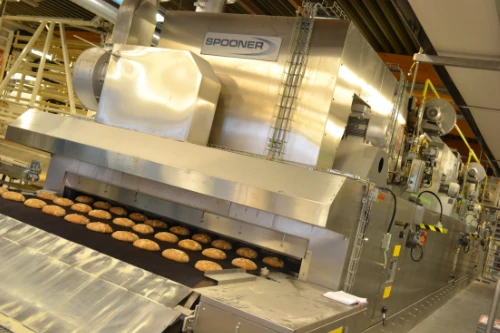
Working within an established bakery, our engineers identified a single bread oven as the focal point for a heat recovery project. Rather than applying a standard solution, we designed an approach built around the site’s existing layout and constraints, capturing 350 kWh of waste heat from the oven’s exhaust and redirecting it to serve adjacent process heating requirements on site. We generated:
- £100,000 in annual energy cost savings
- 350 kWh energy saving
- ROI achieved within two years
The project was subsequently cited in Spooner Industries’ 2026 report Decarbonising Your Bakery, with our director, Jim Colston, recognised as a contributing expert. It’s the kind of clearly evidenced, commercially grounded result that makes a capital project straightforward to present internally.
The Bigger Picture
Heat recovery is often the most immediate opportunity, but it’s rarely the only one. Across the manufacturing sites we work with, the combination of heat recovery, process optimisation, and better system controls routinely delivers annual savings well into six figures, with payback periods that compare favourably against almost any other capital investment a site could make.
With 90 years of thermal engineering experience, we’ve worked across industrial sites of every age and configuration. Legacy buildings are where that depth of knowledge matters most. No two sites present the same set of challenges, and no standard specification can reliably predict what’s possible until you’ve assessed the building in front of you.
If you’re running production from an older factory and want to understand where your energy savings actually sit, talk to our team about a site assessment.