

The Brief
A global leader in responsible flexible packaging sought our support to uncover process inefficiencies and strategies a route forward.
The flexible packaging manufacturer faced critical energy, safety, and environmental compliance challenges at one of its major production sites. Ageing thermal infrastructure, inadequate solvent monitoring systems, and uncontrolled dryer operations were driving excessive gas consumption and production risk.
Energy Inefficiency & Safety Challenges
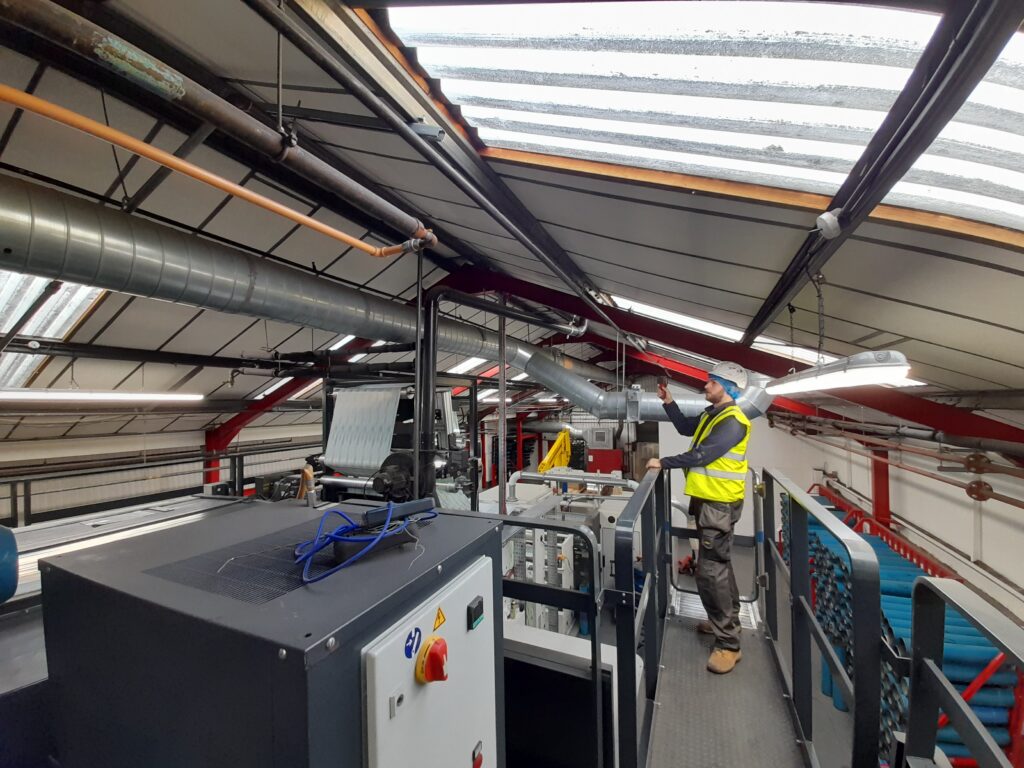
To find the root cause of the inefficiencies, our engineers visited the production site to conduct an in-depth energy audit to uncover problem areas that can be addressed with process optimisation implementations.
| Risk Level | Area | Description | Risk |
| High | Gas Supply | Gas supply cannot meet peak site demand and is vulnerable to interruption during cold weather periods. | The inability to meet site demand can lead to production interruptions and wide-scale business disruption. |
| Medium | Gas Supply | Gas supply limitations restrict equipment use and cause operational failures. | The limitation reduces equipment output and, therefore, production capacity. |
| Medium | RTO Gas Use | High air volumes and low solvent concentrations in dryer exhausts require excessive gas to treat in the RTO. | The excess gas supply leads to higher energy costs and a higher CO₂ burden. |
| Medium | Press Dryer Heating | Uncontrolled dryer settings and poor damper actuation drive unnecessary gas consumption. | The excess gas supply leads to higher energy costs and a higher CO₂ burden. |
| High | Press Dryer Safety | Obsolete LEL solvent monitoring systems are inconsistent and unreliable, limiting confidence in dryer control and presenting a potential safety hazard. | These obsolete systems pose both a safety and production risk. |
The Solution
From the on-site investigation, our engineers drafted a comprehensive optimisation programme, addressing each of the challenges through three interconnected workstreams.
- Press Dryer Optimisation & LEL Upgrade
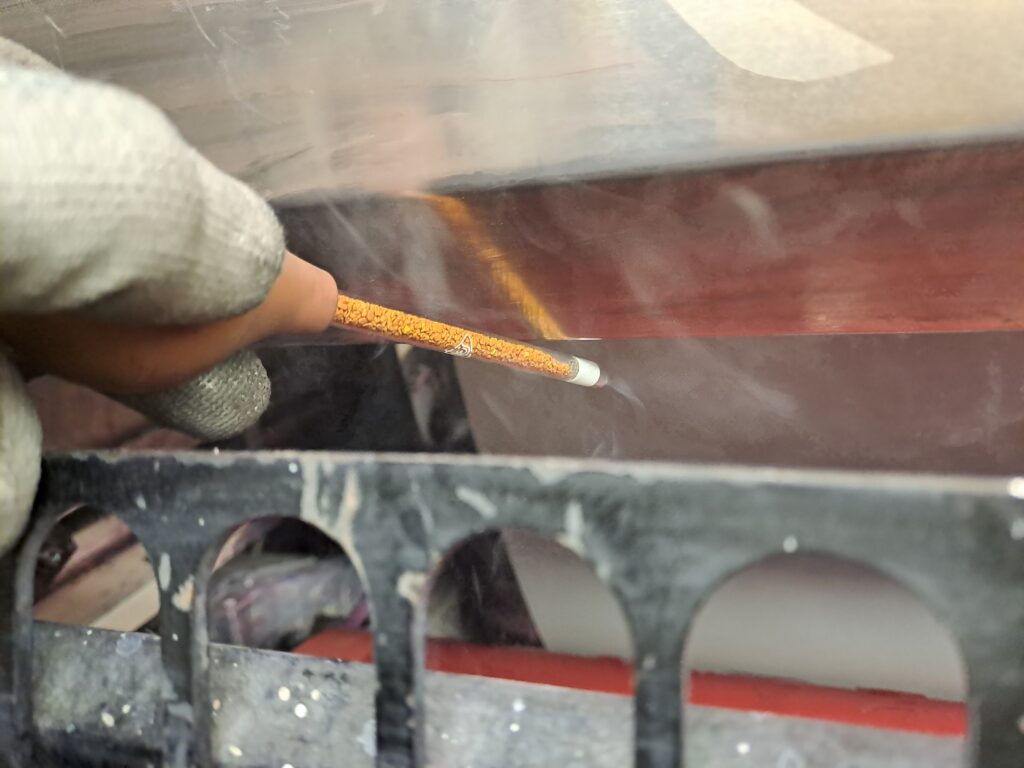
From the physical inspection and measurement of the press dryers, we identified various issues, including dryer nozzles being heavily contaminated, the supply vs exhaust air balance being poor, recirculation and tunnel ducts containing blockages, and LEL sensors leading to inconsistent readings. Each of these were creating inefficiencies in the drying system and resulting in elevated exhaust volumes being passed to the RTO unnecessarily. To address this problem, an in-house cleaning and planned maintenance regime was established for dryer nozzles and ductwork to restore design airflow performance. We recommended upgrading the LEL solvent monitoring system to an upgraded SIL 2-rated system, providing reliable and consistent signals to the dryer control system. Furthermore, the direct-fired gas burners were to be replaced with low-surface-temperature heaters, reducing ignition risk. Finally, the dryer air circuits will be rebalanced with new LEL-controlled recirculation set points, enabling safe operation under EN 1539:2015.
2. Centralised Thermal Oil Process Heating
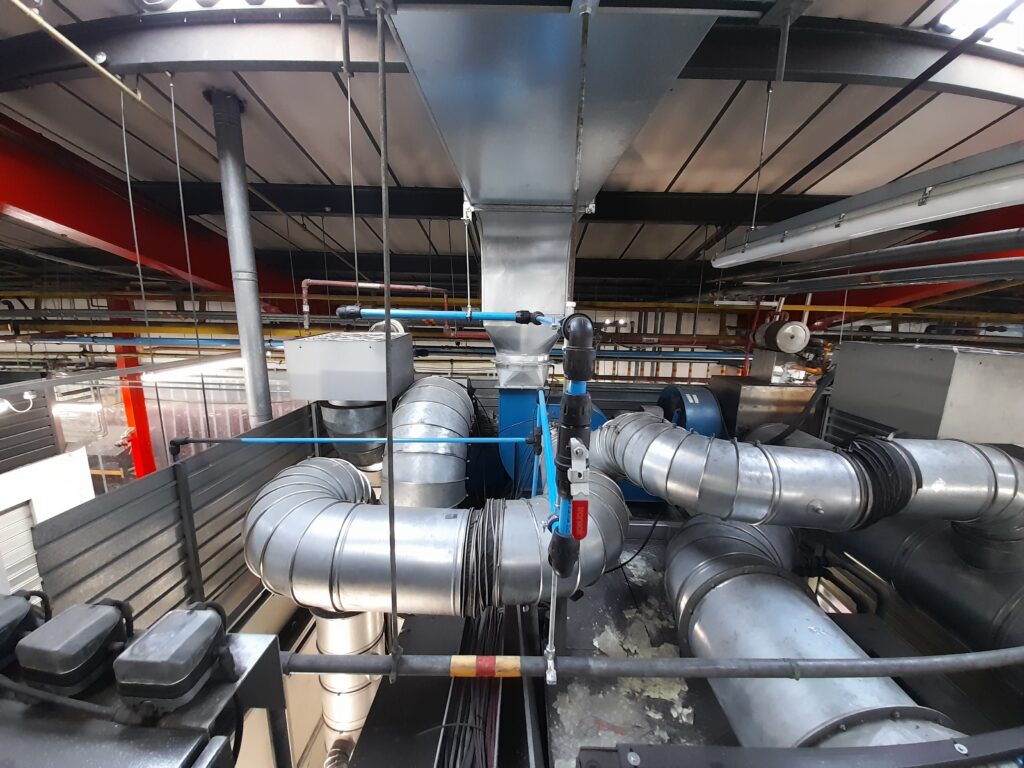
Our engineers further proposed a central thermal fluid process heating system to be installed in a safe external location, which would replace multiple Printing Press burners. Total gas input across the existing burners was approximately 5,600 kW, while the central process heating system will reduce this input to 2,000 kW. This central configuration will also simplify service and maintenance.
3. RTO Exhaust Control & Heat Recovery
From monitoring the RTO performance in the site audit, data confirmed high air volumes (average 43,000 m³/hr, peak 68,000 m³/hr) with average solvent concentrations of only around 1 g/m³ – well below the threshold for Auto – thermal operation, leading to excessive gas usage. As addressed above, the improved dryer exhaust controls reduce the total air volume directed to the RTO and increase solvent concentration. The lower air volumes will directly reduce fan electrical power consumption. As solvent concentrations rise in the exhaust stream, the RTO will be able to reach or exceed its auto-thermal point – the threshold at which combustion becomes self-sustaining, and no supplementary gas input is required. Any surplus heat then generated beyond the auto-thermal point can be recovered via a heat exchanger and fed back into the thermal oil heating system, further improving overall site energy efficiency.
Process Optimisation Implementation Roadmap
The project was structured into five distinct phases, spanning 12 months from initial audit to implementation.
Phase 1 & 2: Challenge identification and initial solution modelling.
Phase 3: Detailed process design, including P&IDs, layouts, and control philosophy.
Phase 4: Equipment scheduling, procurement, and contractor identification.
Phase 5: Staged optimisation, installation and commissioning of the dryers, central thermal fluid process heating, and heat recovery system.
Conclusion
The project demonstrates how a packaging manufacturer can achieve considerable energy savings and safety improvement through process optimisation. The 68% reduction in gas consumption helps alleviate the pressure of rising energy bills, the LEL monitoring system replacements directly address safety risk, and the heat recovery contributes to long-term CO₂ reduction, vital for future environmental compliance.