

Today’s manufacturers face rising input, labour costs and falling investment. With the economic pressures increasing, the industry feels the squeeze more than ever. Implementing new technology is the last thing on the agenda.
Unless it isn’t?
Along with financial pressures, manufacturers are also striving to meet sustainability demands. Heat recovery systems can allow for major cost savings by optimising the energy you already pay for.
We’ll be answering the burning questions manufacturers have, including the big one: Are heat recovery systems really worth it?
What Are Industrial Heat Recovery Systems?
Process Energy creates bespoke industrial heat recovery systems for manufacturing facilities. We capture excess heat generated as a by-product of processes such as cooling and redirect this wasted energy for use elsewhere in the facility. This energy can be reused for preheating combustion air, space heating, or even cooling needs such as absorption chillers.
Our team of experts provide flexible heat recovery solutions that are able to recover heat in many forms, including exhaust gases, hot wastewater and more. While Industrial heat recovery systems are still hugely underused throughout manufacturing, Process Energy have delivered strong results across industries, such as food manufacturing, textiles, printing and packaging, and heavy industries.
Designed to fit around your existing equipment and processes, we provide heat recovery systems for air compressors, boiler flues and combined heat and power engines.
Understanding the Investment
As mentioned, Process Energy work by creating bespoke heat recovery systems, tailored to individual facilities. Every project begins with an in-person audit, where we analyse your entire operation – from exhaust gas temperatures to individual process energy consumption – building a complete picture of where energy enters your system and where it’s lost. This detailed assessment allows us to identify the heat recovery solutions that will deliver the greatest cost savings for your specific facility.
The initial investment depends heavily on the complexity of your operation and the recovery system required. While the initial capital outlay for heat recovery can feel like a barrier, it’s important to view the investment through an operational lens rather than a purely financial one. Heat recovery is not an experimental technology or a future bet. It is a proven method of reducing fuel consumption by making better use of the energy you are already paying for.
At Process Energy, the focus is always on solutions that deliver tangible returns. Following the initial audit, systems are designed to target the most valuable waste heat streams first. High-temperature exhaust gases from ovens, boiler flues or dryers typically offer the fastest payback, while lower-grade heat sources can still provide value when paired with technologies such as heat pumps.
Payback periods vary depending on fuel costs, operating hours and system complexity. In many Process Energy projects, heat recovery systems deliver payback within one to four years, with some schemes achieving even faster returns when carbon savings are factored in. For energy-intensive sectors, this can be even shorter. Beyond direct fuel savings, manufacturers often see additional benefits such as reduced boiler loading, lower maintenance costs, and improved system resilience as reliance on ageing equipment decreases.
Heat Recovery in Action: Major Savings for Manufacturers
In a recent industrial project, a manufacturing facility sought to improve its energy resilience by installing a Combined Heat and Power (CHP) gas engine to generate its own electricity. While the engine met the site’s power needs, a significant opportunity remained: the large volume of heat typically wasted during generation.
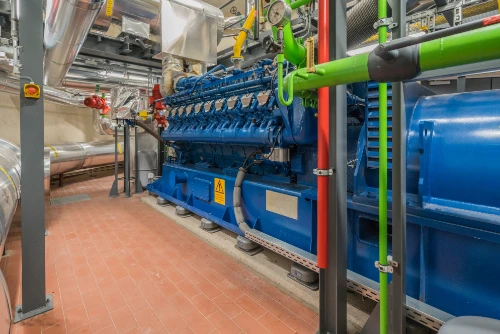
Process Energy conducted an in-depth analysis of the factory’s processes and identified where waste heat from the CHP engine could be most effectively reused. The bespoke solution captured heat from the engine’s waste stream and redistributed it to various energy users across the facility, including process drying, space heating and hot water systems.
Although up to 1,400 kWh of heat could be recovered, the site’s consistent demand averaged about 720 kWh per year of usable heat. This translated into a substantial annual cost saving of £179,000, as recovered heat offset both natural gas and higher-cost electrical heating.
Overall, the project achieved a payback period of less than two years, demonstrating how targeted heat recovery on CHP installations can deliver rapid financial and energy efficiency gains.
A Smarter Return on Energy
For carbon-intensive sectors, heat recovery is not an abstract sustainability upgrade. It is a practical response to rising energy costs and increasing pressure to decarbonise without disrupting production. The return on investment is driven by a simple principle: reducing waste in a system that already runs at scale.
Well-designed heat recovery systems deliver value by lowering fuel consumption, easing the load on boilers and generating dependable savings year after year. When projects are engineered around real operating data, payback periods become predictable rather than speculative.
In many cases, recovered heat replaces energy that would otherwise be purchased at full market cost, creating immediate and measurable financial benefit.
In an industry where margins are tight and energy pressures are increasing; heat recovery stands out as an investment that delivers both cost savings and greater operational control.
Talk to Process Energy today and turn wasted heat into a working asset.